




Responsible Artificial Intelligence
Human-Centered and Trustworthy Responsible AI
AUO promotes responsible AI governance to ensure that AI applications align with security, compliance, and ethical principles, reducing the risks associated with automated decision-making and establishing governance mechanisms that are monitorable, traceable, and adaptable, to fulfill fairness, transparency, and data governance, therefore AUO could ensure stakeholder interests while enhancing organizational resilience in the digital transformation.
AUO AI Ethics Policy
AUO has established the 《 AUO AI Ethics Policy》 as the foundation of its AI governance framework, drawing on internationally recognized standards and guidelines, including the EU AI Act, ISO/IEC 42001, and the OECD AI Principles. The policy is implemented through six core dimensions, and AUO continuously enhances its governance mechanisms in alignment with applicable regulations and evolving standards.
- Governance Foundation: comprises governance structure, stakeholder engagement, sustainable development, and supply chain management.
- Core Dimensions:include Ethics, Transparency & Explainability, Data Security & Privacy Protection, Accountability, Reliability, and Fairness & Non-Discrimination
- Supervision and Improvement: through policy implement oversight, risk monitoring and remediation, capability building and training, and regulatory compliance, we continuously improve our governance mechanisms in accordance with applicable regulations and standards, such as the EU AI Act, ISO/IEC 42001, and the OECD AI Principles.
AUO AI Ethics Governance Framework

Ethics

Transparency and Explainability

Data Security and Privacy Protection

Accountability

Reliability

Fairness and Non-Discrimination
AUO develops and applies AI responsibly based on a human-centered approach. Five principles are integrated throughout the AI lifecycle:•Human-Centered, Trustworthy and Transparent, Fairness and Reliability, Privacy Protection, and Sustainable Development. And, AUO is committed to legal compliance, responsible conduct, respect for diversity, and the promotion of human well-being while prohibiting manipulative practices, social scoring, and unauthorized biometric surveillance
AUO ensures that AI operations and decisions are understandable and trustworthy through a five-step approach:1.Information Disclosure, 2. Operational Transparency, 3. Decision Explainability, 4. User Understanding, 5. Continuous Optimization. Supported by comprehensive documentation, data and model governance, stakeholder communication, and fairness reviews, this approach enables users to understand AI-generated outcomes and recommendations.
AUO safeguards data through five key mechanisms:1. Privacy Protection, 2. Data Security, 3. Access Control, 4. Security Monitoring, 5. Data Governance. These measures include data minimization, encryption, least-privilege access management, threat detection, anomaly monitoring, and lifecycle management to comply with regulatory requirements and enhance user trust.
AUO establishes accountability through a continuous cycle of: 1. Responsibility Assignment, 2. Internal Accountability, 3. Human Oversight, 4. Recordability and Traceability, 5. Continuous Improvement. This ensures that AI systems are auditable, transparent, and subject to human review and intervention when necessary.
To maintain stable and secure AI operations, AUO follows a closed-loop management process: 1. Risk Assessment and Design, 2. Validation and Testing, 3. Monitoring and Detection, 4. Response and Remediation, 5. Continuous Improvement. Potential risks are identified early, systems undergo functional, security, and stress testing, and performance and model drift are continuously monitored to ensure sustainable AI operations.
AUO is committed to preventing bias and discrimination in AI system design and deployment. We continuously monitor and mitigate potential biases to ensure that AI products and services remain fair, inclusive, and free from discrimination against any individual or group.
AI Governance and Management Practices
AUO follows five Responsible AI principles: Human-Centered, Trustworthy and Transparent, Fairness and Reliability, Privacy Protection, and Sustainable Development. Comprehensive governance mechanisms ensure that AI development, deployment, and use comply with ethical, legal, and sustainability requirements.
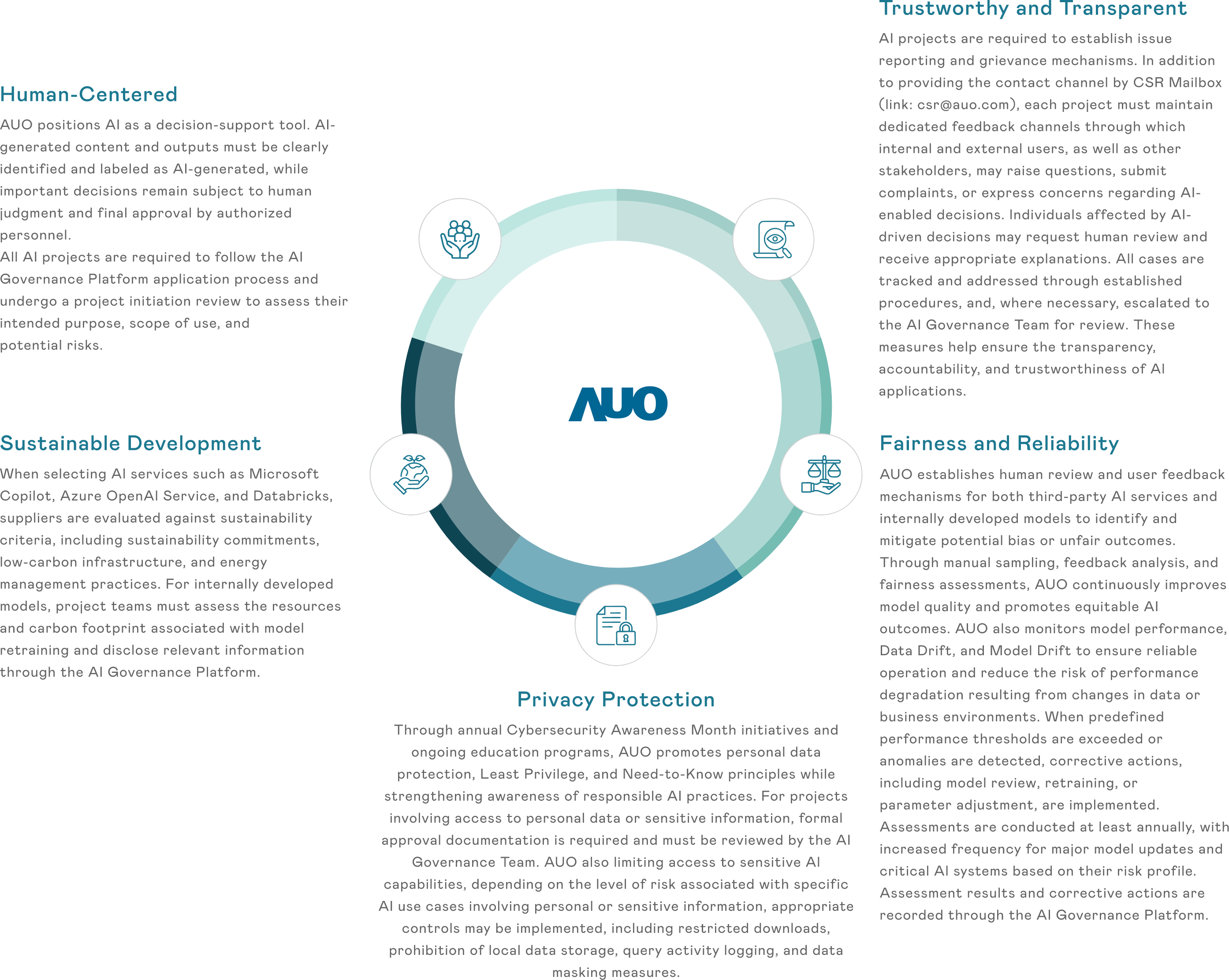

Governance Framework
An AI Governance Team has been established, chaired by the Chief Information Security Officer (CISO), with cross-functional participation from Information Technology, Information Security, Legal, Sustainability. The AI Governance Team is responsible for the governance, oversight, and regulation of AI systems, ensuring that their development and deployment align with ethical principles, legal requirements, and societal expectations. Its tasks include AI project evaluation, risk classification and management, model validation, AI lifecycle management, continuous monitoring, incident management, and internal audits. In addition, the Company strengthens organization-wide AI governance capabilities through regular education and training programs for employees.

Literacy and Capability Building
AUO conducts regular internal audits and training programs to strengthen employees’ awareness and practical capabilities in AI ethics and governance. In 2025, four major training programs were delivered, including “Fundamentals of AI Ethics and Governance,” “Responsible AI Principles and Risk Assessment Workshop,” “Guidelines for the Secure Use of Generative AI and Copilot,” and “AI Vendor Management and International Regulatory Compliance.” A total of more than 3,800 participations were recorded, covering employees from R&D, Manufacturing, Information Technology, Legal, Human Resources, Procurement, Sustainability, and other functions. Completion rates reached 100% among managers and AI project leaders.

Alignment with International Standards
AUO continues to strengthen cross-functional collaboration and enhance its AI risk monitoring and governance framework. By aligning with internationally recognized standards and frameworks, including the EU AI Act, ISO/IEC 42001, the OECD AI Principles, and the NIST AI Risk Management Framework (AI RMF), the Company continuously advances its AI governance maturity and organizational resilience.
AI Application Cases and Results
AUO has progressively implemented multiple AI initiatives, all governed under the Responsible AI framework to ensure lawful data usage, controlled operations, and verifiable outcomes:

Safety Copilot
By applying AI-powered image analytics and contextual recognition technologies to continuously monitor cleanroom environments and proactively identify potential risks. Since its deployment, detection accuracy has increased from 78% to over 92%, false alarms have been reduced by approximately 40%, and inspection workload has decreased by around 15%, enabling personnel to focus on higher-value safety management activities. By integrating event logging, model governance, and human review mechanisms, the solution improves the traceability and reliability of AI-assisted decisions while strengthening workplace safety and responsible AI governance.

Array Auto Repair Inspection and Repair System
The system utilizes AI-powered computer vision technology and historical defect images to establish defect recognition models for panel quality assessment. Following implementation, inspection accuracy improved from approximately 85% to 97%, while inspection time per panel was reduced by around 35% and manual inspection effort decreased by more than 20%, enabling personnel to focus on higher-value activities such as quality analysis and process improvement. Through the integration of human sampling inspections, model governance, and continuous optimization mechanisms, the system improves product quality consistency, reduces misjudgments, rework, and resource waste, and enhances the reliability, traceability, and trustworthiness of AI-assisted decision-making.


